
Jackery Explorer 300 Review: 292Wh with AC and 100W USB-C
Disclosure: GadgetsDiary earns a commission from qualifying purchases made through links on this page. Commissions do not affect how products...
 By GadgetsDiary Editorial Team
Updated November 9, 2026
Disclosure: GadgetsDiary earns a commission from qualifying purchases made through links on this page. Commissions do not affect how products are ranked. See our Affiliate Disclosure and How We Review pages. Safety: Power stations store a large amount of energy for their size. Use the supplied cables, keep the unit ventilated, and follow the manufacturer manual.
The Jackery Explorer 300 292Wh is a small portable power station with a 292Wh LiFePO4 battery, 300W of rated output and a mix of AC, USB-C, USB-A and car outputs. It is aimed at campers, commuters and anyone who wants a light backup for small devices.
This review is based on the manufacturer’s listing and specifications. It is meant for buyers deciding whether a compact unit with AC outlets and a 100W USB-C port is enough for their devices, and how it recharges. Browse more in our Small Power Stations category, and check the notes on weight and solar below before you buy.
Our Verdict
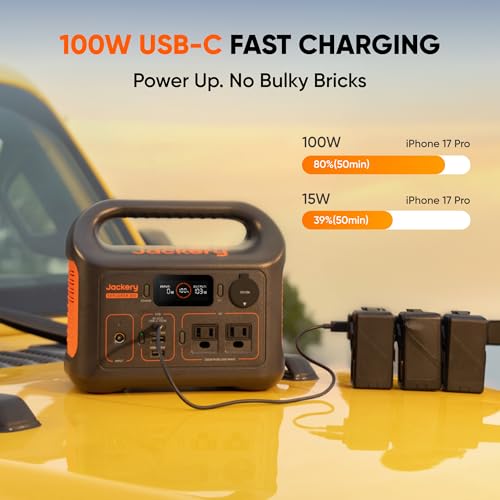
The strongest point of the Jackery Explorer 300 292Wh is its balance of ports and output: the listing gives two AC outlets, a 100W USB-C Power Delivery port, two USB-A ports and a 120W car port, with 300W rated output and a 600W surge.
The main trade-off is that the listing gives two different weights, 7.1 and 7.5 pounds, and the solar panel is not included. It suits campers and commuters who want AC plus fast USB-C charging in a light box. If you need to run heavier appliances, a larger unit is a better fit, and larger units cover that range.

Jackery Explorer 300 Portable Power Station,292Wh




As an Amazon Associate we earn from qualifying purchases. Product prices and availability are accurate as of the date/time indicated.
Key Specifications
| Feature | Specification |
|---|---|
| Brand | Jackery |
| Type | Portable power station |
| Capacity | 292Wh |
| Rated output | 300W, 600W surge |
| Battery | LiFePO4, over 4,000 cycles to 70 percent, per the listing |
| Ports | Two AC, one 100W USB-C PD, two USB-A, one 120W car port |
| Dimensions | 9.1 x 5.2 x 7.8 inches |
| Weight | 7.1 pounds per product data, 7.5 pounds per listing text |
Capacity and Output
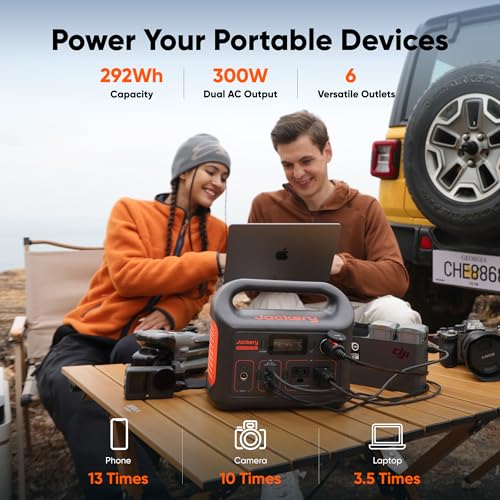
The listing gives a 292Wh capacity with 300W of rated output and a 600W surge. It names laptops, drones and cameras as devices the unit can handle. The outputs are two AC outlets, a 100W USB-C Power Delivery port, two USB-A ports and a 120W car port.
The rated output is the limit for everything connected at once, and appliances with motors may draw more when they start. Add up the running watts of what you plan to power and compare it with 300W. The listing does not give an output rating for the USB-A ports, so check the manual for those. Capacity in watt-hours is the size of the tank, so a heavier load drains it sooner, and the listing gives no runtime figure.
Charging and Setup
The listing says solar charging reaches 80 percent in about 2.8 hours with a 100W Jackery panel. The solar panel is not included, so you buy it separately. The box includes an AC adapter, a car charger cable and a user guide, according to the listing.
The listing does not give an AC recharge time, so we cannot state one. Solar input depends on the panel, its connector and the sunlight, so check panel compatibility in the manual. Follow the manual for charging and storage, and use the supplied cables. Keep the unit ventilated while it charges and away from heat and water.
Build, Size and Portability
The listed dimensions are 9.1 x 5.2 x 7.8 inches. The listing text gives a weight of 7.5 pounds and says it is 17 percent lighter than the industry average, while the product data gives 7.1 pounds. Confirm the weight on the product page.
The battery uses LiFePO4 chemistry, which the listing rates for more than 4,000 charge cycles before reaching 70 percent capacity, or more than 11 years of service life. Treat that as a manufacturer claim. The listing describes an integrated handle and does not state a warranty term. Place the unit on a stable, ventilated surface and keep it out of rain.
Features and Compatibility
The listing highlights six outputs for six devices, and a 100W USB-C Power Delivery port that can charge many laptops. It describes the unit as pairing with Jackery solar panels.
The listing does not mention an app, pass-through charging or a display, so do not assume them. Confirm any feature you rely on on the product page. The listing does highlight the unit as a backup for small gear, but it does not list every supported appliance.
Pros and Cons
| Pros | Cons |
|---|---|
|
|
Who Should Buy It
| Who Should Buy It? | Who Should Look Elsewhere? |
|---|---|
|
|
Final Verdict
The Jackery Explorer 300 292Wh offers two AC outlets, a 100W USB-C port and 300W of rated output in a compact LiFePO4 unit. Its compromise is a modest capacity, an unclear weight and a solar panel sold separately. It suits campers and commuters who want a light backup. Confirm the details on the product page before buying. For a wider view, see our guide to small portable power stations. See the Jackery Explorer 300 292Wh on Amazon.
Frequently Asked Questions
What can the Jackery Explorer 300 292Wh run?
The listing gives 300W of rated output and a 600W surge, and names laptops, drones and cameras as examples. Check each device’s wattage and keep the total under 300W. Appliances with motors may draw more at startup.
How fast does it charge with solar?
The listing says it reaches 80 percent in about 2.8 hours with a 100W Jackery solar panel. The panel is not included. Real times depend on sunlight, the panel and conditions.
Does it have a USB-C port for laptops?
Yes. The listing describes a 100W USB-C Power Delivery port. Check your laptop’s charger rating and use a cable that supports that power.
How heavy is it?
The listing text says 7.5 pounds and the product data says 7.1 pounds. Check the product page for the current figure before you buy, especially if you plan to carry it far.
About the author

The GadgetsDiary editorial team compares portable power and charging products using manufacturer specifications and Amazon listing data. Read how we choose and rank products on our How We Review and Editorial Policy pages.