
6 Best Small Portable Power Stations of 2026
Disclosure: GadgetsDiary earns a commission from qualifying purchases made through links on this page. Commissions do not affect how products...
 By GadgetsDiary Editorial Team
Updated November 9, 2026
Disclosure: GadgetsDiary earns a commission from qualifying purchases made through links on this page. Commissions do not affect how products are ranked. See our Affiliate Disclosure and How We Review pages. Safety: Power stations store a large amount of energy for their size. Use the supplied cables, keep the unit ventilated, and follow the manufacturer manual.
Small portable power stations fill the gap between a power bank and a full-size unit, with enough capacity to run a laptop, lights and small gear for a weekend. This guide compares six models from Jackery, BLUETTI, Anker, EcoFlow and EnginStar, all in the 245Wh to 296Wh range, for campers, commuters and anyone who wants a light backup for short outages.
We compared each model on capacity, rated output, outlets and ports, recharge options, weight and warranty, using the specifications in the Amazon listings. Browse more in our Small Power Stations category. If you need far more energy, see our guide to portable power stations for home backup, and check whether you need AC outlets at all before you choose.
All Products Compared
| Product | Best For | Capacity | Rated Output | Outlets and Ports | Notable Feature |
|---|---|---|---|---|---|
| Jackery Explorer 300 292Wh | Best overall | 292Wh | 300W, 600W surge | 2 AC, 1 USB-C (100W), 2 USB-A, car port (120W) | LiFePO4, 4000+ cycles per listing |
| BLUETTI Elite 30 V2 288Wh | Higher output | 288Wh | 600W, 1500W in Power Lifting mode | AC outlet, others not listed | 10ms UPS switchover |
| Anker SOLIX C300 DC 288Wh | USB-C charging | 288Wh | 300W | No AC. 4 USB-C (up to 140W), 2 USB-A, car socket | 3-year guarantee |
| EcoFlow RIVER 3 245Wh | Fast AC recharge | 245Wh | 550W | Not listed | Full AC recharge in 1 hour |
| Anker 521 PowerHouse 256Wh | Long warranty | 256Wh | 300W, 600W surge | 2 AC, 2 USB-A, 1 USB-C, car outlet | 5-year warranty |
| EnginStar 296Wh 300W Power Station | Pure sine AC | 296Wh | 300W | 2 AC | AC recharge in about 7 hours |
| Award | Product | GadgetsDiary Score About GadgetsDiary ScoreThe GadgetsDiary Score is our own rating from 0 to 10, based on performance, design and build, ease of use, and value. It reflects independent research and is never influenced by manufacturers, retailers, or affiliate commissions. Learn more › | Price | |
|---|---|---|---|---|
| Best Premium |
 Jackery Explorer 300 Portable Power Station,292Wh |
$289.00 | Buy | |
 BLUETTI Elite 30 V2 Portable Power Station 288Wh |
$289.99 | Buy | ||
| Best Budget |
 Anker SOLIX C300 DC Portable Power Station, 288Wh |
$199.99 | Buy | |
| Best Value |
 EF ECOFLOW Portable Power Station RIVER 3 |
$249.00 | Buy | |
 Anker 521 Portable Power Station Upgraded |
$259.99 | Buy | ||
| Best Overall |
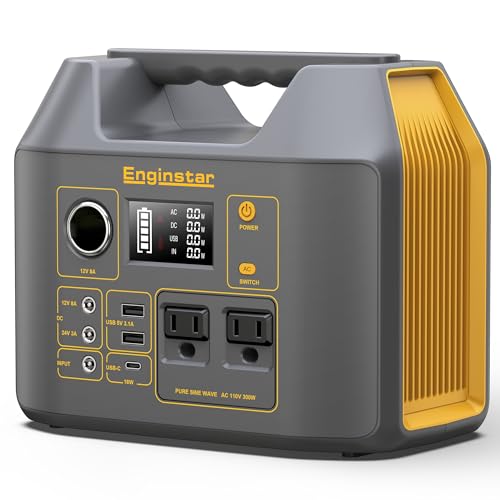 EnginStar 296Wh Portable Solar Generator |
$132.29 | Buy |
Jackery Explorer 300 Portable Power Station,292Wh
BLUETTI Elite 30 V2 Portable Power Station 288Wh
Anker SOLIX C300 DC Portable Power Station, 288Wh
EF ECOFLOW Portable Power Station RIVER 3
Anker 521 Portable Power Station Upgraded
EnginStar 296Wh Portable Solar Generator
Top 3 Small Portable Power Stations Reviewed
#1 Jackery Explorer 300 292Wh: Best Overall
Why We Picked It
The Jackery Explorer 300 292Wh ranks first because it balances capacity, output and ports better than the other small units here. It lists 300W of rated output with a 600W surge, two AC outlets, a 100W USB-C Power Delivery port, two USB-A ports and a 120W car port, so it can run a laptop, a drone charger and lights from one box.
The listing says it uses a LiFePO4 battery rated for more than 4,000 cycles to 70 percent capacity, and that a 100W Jackery solar panel reaches 80 percent in about 2.8 hours. Against the BLUETTI Elite 30 V2, it lists lower output but a lower weight. Against the Anker SOLIX C300 DC, it adds AC outlets that the Anker lacks.
Key Specifications
- Capacity: 292Wh, LiFePO4
- Output: 300W rated, 600W surge
- Ports: two AC, one 100W USB-C, two USB-A, one 120W car port
- Solar: about 2.8 hours to 80 percent with a 100W panel, per the listing
- Size and weight: 9.1 x 5.2 x 7.8 inches, 7.1 pounds per the product data
| Pros | Cons |
|---|---|
|
|
Things to Consider
Confirm the weight on the product page, since the listing text and the product data differ. The solar panel is sold separately, according to the listing, so budget for it if you want off-grid recharging. Check that your largest appliance falls within the 300W rating, including any startup surge.
Best For
Campers and commuters who want AC outlets, fast USB-C charging and a manageable weight.
Skip It If
Skip it if you need more than 300W of AC output or more than a weekend of power, since it lists 292Wh.
See the Jackery Explorer 300 292Wh on Amazon.
#2 BLUETTI Elite 30 V2 288Wh: Best for Higher Output
Why We Picked It
The BLUETTI Elite 30 V2 288Wh takes second place because it lists 600W of continuous output, against 300W for the Jackery, and 1500W in Power Lifting Mode. The listing also states a UPS switchover within 10ms, which suits keeping a router or computer running through a short outage.
It lists fast wall charging at up to 380W, with 0 to 80 percent in 45 minutes and 0 to 100 percent in 70 minutes, and a matching PV60L solar panel for on-the-go recharging. Against the Jackery, it lists higher output and faster recharging at a higher listed weight of 9.5 pounds. Against the EcoFlow RIVER 3, it lists more capacity and similar output.
Key Specifications
- Capacity: 288Wh, LFP battery
- Output: 600W continuous, 1500W in Power Lifting Mode
- UPS: switchover within 10ms, per the listing
- Recharge: 0 to 80 percent in 45 minutes by wall, per the listing
- Size and weight: 9.8 x 7 x 6.6 inches, 9.5 pounds
| Pros | Cons |
|---|---|
|
|
Things to Consider
Power Lifting Mode is a special setting, so read what it does and which appliances it supports before relying on it. The listing summary does not list every port, and it gives two weights, 9.4 and 9.5 pounds, so confirm both on the product page. Heat-producing appliances may still need more than a unit this size can supply.
Best For
Users who run higher-wattage small appliances and want quick wall recharging.
Skip It If
Skip it if weight is your main concern, since it is the heaviest model here by listed weight.
See the BLUETTI Elite 30 V2 288Wh on Amazon.
#3 Anker SOLIX C300 DC 288Wh: Best for USB-C Charging
Why We Picked It
The Anker SOLIX C300 DC 288Wh takes third place because it is built around USB-C. It lists two 140W two-way USB-C ports, a 100W USB-C port, a 15W USB-C port, two 12W USB-A ports and a 120W car socket, in a body of 4.89 x 7.87 x 4.72 inches and 6.17 pounds, the lowest listed weight in this guide.
The listing states a LiFePO4 battery with a three-year guarantee, and recommends a 100W or 60W Anker solar panel. It has no AC outlet, which is the key difference from the Jackery and the BLUETTI. For laptop and phone use, that trade-off buys a smaller, lighter unit with fast USB-C ports.
Key Specifications
- Capacity: 288Wh, LiFePO4
- Output: 300W
- Ports: two 140W USB-C, one 100W USB-C, one 15W USB-C, two 12W USB-A, one 120W car socket
- Guarantee: three years, per the listing
- Size and weight: 4.89 x 7.87 x 4.72 inches, 6.17 pounds
| Pros | Cons |
|---|---|
|
|
Things to Consider
This is a DC power station, so it cannot run anything that needs a wall outlet. The listing says first-time activation needs an 18W or higher USB-C wall charger, and it notes limits on which Anker solar panels work. Confirm that your devices charge over USB-C or the car socket before you buy.
Best For
People who charge laptops, phones and cameras over USB-C and want the lightest unit.
Skip It If
Skip it if you need to plug in a lamp, fan or other AC device, since it has no AC outlet.
See the Anker SOLIX C300 DC 288Wh on Amazon.
How to Choose a Small Portable Power Station
Capacity and Rated Output
Capacity in watt-hours is the size of the tank, and rated output in watts is how much you can draw at once. Add up the running watts of what you want to power, and choose a unit whose output clears that total with room to spare. Small units suit laptops, lights, fans and phones, not heaters or kitchen appliances. Runtime depends on the load and conditions, so treat any simple calculation as a rough guide, and leave a margin for losses and cold weather.
Outlets and Ports
Decide what plugs in. AC outlets run lamps and fans, USB-C Power Delivery charges laptops directly, and a car port or DC output suits vehicle accessories. Some small units skip AC entirely to save weight, so check before you buy. Look at the wattage per port and whether the top output is shared. Pure sine wave AC is a safer choice for sensitive electronics, though not every listing states the waveform. Check the port list in the listing itself rather than assuming, because summaries often leave details out.
Recharge Options (Wall, Car, Solar)
Check how the unit refills and how long it takes. Wall charging is fastest, car charging is a useful fallback and solar suits long trips. Solar panels are often sold separately, and each unit accepts a limited input range and connector, so match your panel to the listing. Some units refill quickly while others take most of a day. Read the stated times as best-case figures that depend on the charger and the conditions. A unit that refills quickly is easier to rely on when you are moving between stops.
Weight and Portability
Small units are meant to move, so weight, shape and handle design matter. Compare the listed weights, but read carefully, because some listings give different figures in different places. Check where it will live in your car or tent, and whether it needs a bag or strap. Weight also affects how likely you are to bring it, which matters more than a spec for a unit meant for short trips. Think about lifting it in and out of a car boot as well.
Battery Chemistry and Safety
Many small units use LiFePO4 cells, chosen for long cycle life and thermal stability, and listings often quote a cycle count. Treat those numbers as manufacturer claims. Use the supplied cables, keep the unit ventilated and away from heat, and stop using it if it swells or overheats. Never leave it charging unattended in a hot vehicle, and keep the manual so you know the stated temperature limits. For even smaller needs, see our Power Banks, or step up to larger Portable Power Stations.
How We Evaluate Small Power Stations
We evaluate small power stations by comparing manufacturer specifications, Amazon listing information and available buyer ratings. We weigh each model on fit for small loads, capacity, rated output, outlets and ports, recharge options, weight, safety information, warranty and value. Amazon does not supply ratings for these products through our data source, so the rankings rely on published specifications rather than review scores. Listings can be inconsistent, so confirm capacity, rated output, outlet types and device compatibility for the exact model before you buy. Commissions do not affect rankings, and we update the guide when listings change.
Frequently Asked Questions
What can a small portable power station run?
Small devices such as phones, laptops, lights, fans and cameras, within its rated output. The Jackery Explorer 300 292Wh listing mentions laptops, drones and cameras. Add up your devices’ running watts and compare the total with the unit’s rating before you rely on it.
Can a small power station charge a laptop?
Yes, if its output matches your laptop’s charger. The Jackery Explorer 300 292Wh lists a 100W USB-C port, and the Anker SOLIX C300 DC 288Wh lists two 140W USB-C ports. Check your laptop charger’s rating and use a cable that supports that power.
Do I need an AC outlet on a small power station?
Only if you plan to run AC devices such as a lamp or a fan. The Anker SOLIX C300 DC 288Wh has no AC outlet and relies on USB-C and a car socket. If you are unsure, choose a model with at least one AC outlet.
Can I recharge a small power station with solar?
Many models can, but the panel is usually sold separately. The Jackery Explorer 300 292Wh listing quotes about 2.8 hours to 80 percent with a 100W Jackery panel, while the EcoFlow RIVER 3 245Wh lists 2.6 hours with 110W solar input. Check the input range for your panel.
How should I store a small power station?
Follow the manual. In general, keep it in a cool, dry place away from heat and flammable materials, and recharge it periodically as the manufacturer recommends. The EnginStar listing suggests topping it up every few months. Do not use it if it is swollen, damaged or very hot.
Final Verdict
The Jackery Explorer 300 292Wh is the strongest overall option in this guide because it combines AC outlets, a 100W USB-C port and a stated long cycle life at a manageable weight. If you need more output for higher-wattage small appliances, the BLUETTI Elite 30 V2 288Wh is the alternative to consider, at the cost of extra weight. Whichever you choose, decide first whether you need AC, match the rated output to your devices, confirm the specifications on the product page, and follow the manual for charging and storage. A small unit that fits your real devices will beat a bigger one you leave at home.
About the author

The GadgetsDiary editorial team compares portable power and charging products using manufacturer specifications and Amazon listing data. Read how we choose and rank products on our How We Review and Editorial Policy pages.